Check out my rundown of the 2010 Senate races here

Friday, October 17, 2008

Will Colin Powell Endorse Obama?

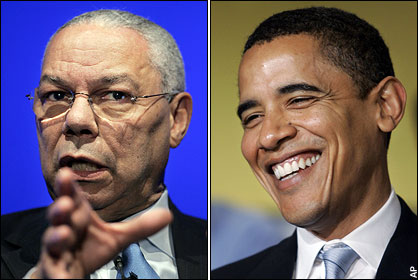
Retired Gen. Colin Powell, a national security adviser to the last three Republican presidents, now may endorse Barack Obama, according to Republican sources. The rumors of this endorsement began to spread after it was announced that Powell would appear on "Meet the Press" this Sunday.

Powell has effectively stayed out of the political arena since he stepped down from his position of Secretary of State under President Bush in 2004, and no one has any idea what he's going to say on Sunday.

An endorsement from Powell at this point in the campaign could be big for Obama. As of now, Powell is the biggest name in politics that remains on the sidelines of this presidential race. Endorsements don't carry as much weight as they used to, but if Powell threw his support behind Obama, it would get several days worth of coverage and would dominate the news cycles.

It also might reassure some undecided voters who are concerned about voting for an African-American they don't know by hearing some validation from an African-American they know and respect. Powell holds an unusual position in American politics as a respected elder political figure who was never president, and was also talked about as the possible first African-American nominee of a major party back in 1996.

In addition, with Powell's unassailable national security credentials, an endorsement could also reassure some undecided voters who are unsure if Obama is ready to be commander-in-chief, and it would essentially erase any advantage John McCain would have on national security come election day.

Some McCain advisers have a bad feeling in their gut that he will announce his support for Obama on Sunday. “It’s going to make a lot of news, and certainly be personally embarrassing for McCain," a McCain official said. "It comes at a time when we need momentum, and it would create momentum against us.”

A friend and ex-aide said that Powell was extremely "upset" by the "vitriol, bile and prejudice" aimed at Obama on the campaign trail. However, Powell is a long-time Republican and friend of John McCain.

I am not convinced that he will come out and endorse either candidate (yes, it is possible that he will endorse McCain) on Sunday. He may appear to lean toward one candidate or the other (probably Obama), but he's a cautious guy, so he probably won't make any sweeping statement or endorsement in full support of either candidate on "Meet the Press."

Rumors of him coming out to endorse Obama surfaced during the primaries and around the time of the conventions, but to no effect. Also, he has managed to stay out of partisan politics for four years now, and I am not convinced that he will just dive in all of a sudden.

Of course, if he strongly believes that Obama will win anyway, he may just jump on the bandwagon so he can get a national security position in Obama's cabinet. But given Powell's reputation for dignity and honesty, that is very unlikely. We'll just have to wait and see what happens on Sunday.

UPDATE: Sources close to Powell say that he will probably stop short of a formal endorsement of Barack Obama on "Meet the Press" on Sunday morning, and it is expected to be more implied than explicit. A well-informed source told the New York Daily News: "After Sunday people aren't going to have any doubt who he's voting for." Full story here.

Supreme Court Sides with Ohio Dems

Here's the ruling from the Supreme Court that came out today regarding voter registration in Ohio, courtesy of Bloomberg:

The U.S. Supreme Court, siding with Democrats, freed Ohio officials from a lower court order that might have limited participation by new voters in next month's presidential election.

Today's ruling means Ohio Secretary of State Jennifer Brunner, a Democrat, doesn't have to provide county election boards with lists of new registrants whose information doesn't match up with government databases. A federal trial judge had ordered Brunner to supply the lists by today.


Republicans who sued Brunner "are not sufficiently likely to prevail'' in their lawsuit, the Supreme Court said in a two- page order, which came without published dissent.


Brunner said the judge's order could have affected as many as 200,000 Ohioans, potentially forcing them to cast provisional ballots instead of regular ballots. Democrats likely would have been disproportionately affected by the judge's order because of the party's efforts to register new voters this year.


The Ohio Republican Party accused Brunner of ignoring her duty under a federal law to help weed out fraudulent registrations. The dispute was one of several fights that have made Ohio a center of legal controversy leading up to the Nov. 4 election.


This is surely a big win for the Democrats and will save them a lot of trouble, but I don't think that it will make a big difference in the outcome of the race in Ohio. But who knows.

Thursday, October 16, 2008

McCain Strong But Angry in Final Debate

John McCain faced off against Barack Obama for the third time in what may well have been the final debate of his political career. The two met at Hofstra University on Long Island last night, and the stakes could not have been higher--well, at least for McCain.

The bottom line for McCain--as all the pundits tirelessly repeated in the coverage before the debate--was that he needed a game changer. He needed to go on the attack and put Obama in a defensive position.

All Obama needed going in was to not commit any major mistakes and to avoid an embarrassing "YouTube moment." His other job in the debate was to not look like he was too confident or complacent with his recent lead in the polls.

For the first half hour of the debate, McCain came out strong, passionate, lively, and a tad bit angry--which I think came across well to viewers. He came out swinging against Obama and attacked him successfully on his economic policies and government spending.

McCain had one of the best lines of the night after Obama was comparing him to President Bush: "Senator Obama. I am not President Bush. If you wanted to run against President Bush, you should have run four years ago." McCain also scored unintentionally by calling Obama "Senator Government" by accident early on in the night. The dials on CNN of a group of uncommitted voters in Ohio responded well to McCain in the first thirty minutes.

But the tide of the debate began to turn when the moderator, Bob Schieffer of CBS (who did a fantastic job, by the way), asked if there was anything that either candidate wanted to say to each other's face. He was of course implying that McCain should bring up William Ayers, but McCain essentially wussed out.

Instead, he started talking about Rep. John Lewis's comments about how hateful his campaign had gotten and how McCain and Palin's town hall-style rallies reminded him of George Wallace and the angry pro-segregation sentiment of the 1960s. McCain again asked Obama to repudiate those comments, and tried to paint the picture that Obama was principally responsible for the negative tone of the campaign. But voters came into the debate thinking by a 2:1 margin that McCain was running a negative campaign and Obama a positive one. Fighting that kind of perception is futile and a waste of time.

A few moments later, McCain brought up Ayers and ACORN:

Mr. Ayers, I don't care about an old washed-up terrorist. But as Senator Clinton said in her debates with you, we need to know the full extent of that relationship.


We need to know the full extent of Senator Obama's relationship with ACORN, who is now on the verge of maybe perpetrating one of the greatest frauds in voter history in this country, maybe destroying the fabric of democracy. The same front outfit organization that your campaign gave $832,000 for "lighting and site selection." So all of these things need to be examined, of course.


Then, he added this:

And it's not the fact -- it's not the fact that Senator Obama chooses to associate with a guy who in 2001 said that he wished he had have bombed more, and he had a long association with him. It's the fact that all the -- all of the details need to be known about Senator Obama's relationship with them and with ACORN and the American people will make a judgment.


And my campaign is about getting this economy back on track, about creating jobs, about a brighter future for America. And that's what my campaign is about and I'm not going to raise taxes the way Senator Obama wants to raise taxes in a tough economy. And that's really what this campaign is going to be about.


So basically what he is did was mere seconds after bringing up Ayers and ACORN--which polls have shown time and again that most voters don't care about--McCain flatly said that his campaign has always been and still all about the economy. That is absolutely ridiculous, and clearly the voters watching didn't buy it.

From there on out, McCain was tense, angry, smug and sarcastic, and did not look at all presidential, while Obama kept his poise and stayed in control. McCain's legendary short temper certainly came out last night in full form. The split screens that were featured for the first time on the major news networks certainly did not help McCain, especially in the last hour of the debate. He was blinking like crazy and doing this really weird tongue jut thing, especially when he was getting angry at Obama.

Something that McCain brought up right off the bat and repeated throughout the debate was the ballad of Joe
Wurzelbacher (McCain actually got his last name wrong, but hey, no one's perfect), better known as Joe the Plumber. He used Joe as a jumping-off point for his charge that Obama's tax plan would hurt small-business owners like Joe. He mentioned Joe's name no fewer than 20 times throughout the night, and he seemed to score some points initially with the Joe the Plumber exchanges. Both McCain and Obama addressed Joe directly dozens of times, but I think that McCain won most of those exchanges.

So who won this thing? Well, let's turn to the insta-polls taken right after the debate.

The CNN/Opinion Research poll taken right after the debate found that Obama won, 58% to 31%--almost a 2-1 margin. It also found that on the issue of the economy, 59% said Obama would manage it better and 24% said McCain would. Respondents also preferred Obama's stance on taxes 56% to 41% and also his stance on health care by 62% to 31%. The people polled also said Obama expressed his views better, was the stronger leader, was more likable, and was less of a typical politician.

A CBS poll of 638 uncommitted voters showed a similar result and found that Obama won 53% to 22%--more than a 2-1 margin. And a MediaCurves poll found that independents thought that Obama won 60% to 30%.

Personally, I thought that this was by far McCain's best performance out of the three debates. He started off crisp and strong and clearly had the advantage in the first 20-30 minutes. But Obama deflected his attacks very well and did not make any gaffes of any kind. And when McCain was getting angry and fired up and started to look un-presidential in the last hour, Obama stayed cool, calm, collected, and focused.

It also seemed that Obama was trying to appeal to moderates, independents and undecided voters while it seemed like McCain was still trying to appeal to conservatives (with the exception of his Bush comment). Maybe it was just me, but it did seem a little bizarre that he was still trying to earn brownie points with the right, when it is clear that they fully support him and Sarah Palin.

Here's the bottom line. With 19 days until election day, McCain needed to change the dynamic of the race last night. This was his last chance to convince the public that they should be scared of Obama, whether it was with Ayers, Wright or just on his liberal policies, and he didn't accomplish that last night. But let me be clear. I think McCain did very well last night--just not well enough to make a real difference. I fully expect his poll numbers to go up a point or two over the next few days, but it won't be the drastic change that he needs to turn this thing back into a horse race.

This race is now about Barack Obama and Barack Obama alone. John McCain can keep on trying his current strategy, but I don't think it will make much difference at this point. It is clear that the majority of voters are tired of Bush and the Republicans and want change. McCain has attempted to claim that he is also a change agent, but I don't think that most voters are buying it. The only question that remained was whether the American people believed that Obama was up to the job. And after the public crowned Obama the winner of all three presidential debates, it is clear that they now think that he's up to it.

If the dynamic of the race does not change from what it is right now, we could be in for an early night on November 4. Here it is in a nutshell: McCain can't beat Obama. He has to hope that Obama somehow beats himself.
Wednesday, October 15, 2008

The Supreme Court Stakes

One issue that has being largely ignored over the course of this long campaign is the next president's power to significantly alter the make-up of the Supreme Court. Here is a list of the current justices and their ages:


John Paul Stevens, 88
Ruth Bader Ginsburg, 75
Antonin Scalia, 72
Anthony Kennedy, 72
Stephen Breyer, 70
David Souter, 69
Clarence Thomas, 60
Samuel Alito, 58
John Roberts (Chief Justice), 53

Above, the justices colored blue tend to be more judicially liberal and the justices colored red tend to be more judicially conservative. Justice Kennedy, who is colored black, is a moderate and a swing vote in the court.

Over the course of the next four years, it is likely that at least two of the current justices will step down.

Justice Stevens in 88 years old, and is the most likely to retire. He was probably hoping desperately for John Kerry to win the presidency in 2004 so he could retire, but has since stayed the course through Bush's second term in hopes of a Democrat replacing him on the bench in.

Justice Ginsburg is the second oldest on the court and has had a bout with cancer in the past. It is widely believed that she wants to retire in the next four years, but like Stevens, she is on the liberal side and most likely wants to wait for a Democrat to replace her.

Justices Scalia and Kennedy are the next oldest, but show no real signs of wanting to retire. The same is true for Justices Breyer and Souter.

Justices Thomas, Alito, and Roberts, who are all very conservative, are very young for Supreme Court justices and will all probably serve for at least another twenty years (unless, God forbid, something were to happen to them).

Now, let's look at how the courts will change under the next president. Let's assume that Stevens and Ginsburg will retire in the next four years.

If Barack Obama is elected president, he would replace those two old liberal judges with two younger liberal judges, thus maintaining the equilibrium in the court and the liberals and conservatives will remain evenly split. Think of it as maintenance work. His judges would most likely support a "Living Constitution," which means they would support adapting the interpretation of the Constitution to fit with the times.

If John McCain is elected, we would see a much more drastic shift in the court. He would replace the two retiring liberal judges with younger conservative judges and will undoubtedly act to further his party's philosophy. He voted for the Roberts and Alito nominations, both of which Obama opposed, and he holds up both as models for the kind of judges he would appoint. The court would flip strongly in favor of the conservatives, and the court's decisions would reflect that majority.

It is likely that Roe v. Wade would be overturned, which would be a nightmare for liberals everywhere. The conservative majority would also probably eliminate race-based preferences in the public sector (affirmative action), strengthen the government's role in fighting terrorism, and might even facilitate a larger role for religion in public life, among many other things.

Clearly there is a lot more at stake in this election than most people realize. This election is about more than just the economy, the war in Iraq, alternative sources of energy, health care, you name it. It is about the future of the many issues that many Americans hold dear, and most of them probably don't even realize that their vote in this election could affect many of those things in the long haul. I am amazed that the court has gotten so little attention.

Monday, October 13, 2008

Is Obama Really Winning West Va. & North Dakota?

The most recent two most recent state polls out of West Virginia and North Dakota show Barack Obama ahead in both. These are states that should not even be remotely in play.

First there was a poll from American Research Group on Thursday that showed Obama up by eight points over John McCain in West Virginia, 50-42. I dismissed the poll as an outlier and probably a fluke, seeing as ARG does not have the best track record for accurate polling. Several pundits seem to agree with me in my skeptical assumption.

But today, a new Forum poll put Obama up by two points over McCain in North Dakota--a very solid red state--by a margin of 45-43. This result comes about a month after Obama pulled out all of his staffers there and basically ceded the state to McCain.

Now, I am skeptical of this poll as well, although it does make me a little less skeptical of the West Virginia poll taken last week, and I think--unless both of these polls are flukes--that we're seeing a fundamental shift everywhere on the electoral map toward Obama as a result of the economic crisis.

I still do not believe that Obama will win these states, but these polls do make you wonder how competitive they really are. McCain can't afford to spend time or money in states like these, states that he should carry with ease. For God's sake Bush beat Kerry in West Virginia by 13 points and in North Dakota by 27 points.

But these results make me seriously consider the fact that we might be on the verge of an Obama landslide. The current electoral count at RealClearPolitics.com, a right-leaning site, is Obama 364, McCain 174. Another site, Electoral-Vote.com, gives the race to Obama by a margin of 346-181, with Missouri (11 EV's) tied.

Obama is currently leading in virtually every battleground state (with the exception of Indiana), and his lead in the national polls--now about seven points--has not subsided in the past two weeks. If the economy continues on this current path and Obama's numbers look this good on election day, we may see states like West Virginia and North Dakota go blue.

Sunday, October 12, 2008

Clintons to Stump for Obama

With the exception of a handful of speeches and isolated fundraising events, Bill and Hillary Clinton had not really lived up to their vow that they made at the Democratic National Convention that they would do anything in their power to get Barack Obama elected president of the United States.

But now, that's all changing. Both Clintons are meeting with Obama's running mate, Joe Biden, for a rally in Scranton, Pennsylvania--a working class town where both Hillary and Biden have roots--to campaign for their former nemesis.

After the rally, the Clintons will divide and conquer, following separate itineraries through a series of battleground states. According to the Associated Press, they will also campaign for Democratic House and Senate candidates who are in tight races across the country.

After the Scranton rally, Bill will head to Richmond and Roanoke, Virginia--a state with 13 electoral votes that have not gone for a Democrat since Lyndon Johnson in 1964 that Obama hopes to pick up. Bill has also planned events in two battleground states that he won in 1992 and 1996, Ohio and Nevada.

Hillary will remain in Pennsylvania for the next few days, holding a fundraiser for Obama tonight outside of Philadelphia, and then will hold a rally for him Monday in Montgomery County, a Philadelphia suburb loaded with swing voters.

Hillary beat Obama by about nine points in the Pennsylvania primary in April, and the Obama campaign believes that she can be the most useful there, especially among those white working class voters that propelled her to victory in the state.

John McCain is still making a strong play for the state and its 21 electoral votes, even though his poll numbers do not look good at all. In fact, the last five polls taken in the state have him down by double digits, including a poll from Strategic Vision, which has historically leaned heavily towards Republican candidates. Maybe their internals look better?

In addition to Pennsylvania, Hillary has also planned return visits to Ohio and Florida in the next few days. It has also been reported that she has scheduled a trip to Omaha, Nebraska in an attempt to pick up that one electoral vote from Nebraska's second congressional district that seems to be in play. She also plans to make a stop in Minnesota.

On Friday, she traveled to Arkansas--that's right, Arkansas--which of course is Bill's home state and where she served 12 years as first lady, in hopes of making it more competitive for Obama. Fat chance.

She also might be making a swing through the western battleground states such as New Mexico, Colorado, and Nevada to shore up support for Obama with the Latino vote that so favored her in the primaries.

Hillary did a series of radio interviews this week in North Carolina, usually a reliable red state but one that has turned into a battleground this presidential election. She also spoke to a Hispanic station in Florida and launched a women's canvass in Wisconsin Saturday by phone.

She has made the claim that we need a Democrat in the White House during these hard economic times and this financial crisis. During the primaries, Clinton was seen as more fit to deal with economy than Obama.

So now that Bill and Hill are about to go all out for Obama in the home stretch, they can say that they lived up to their promise. If Obama loses this year, there is little doubt that Hillary will get the Democratic nomination in 2012, and there will not be as much bad blood with her and Obama supporters because she can say that she did everything she could to get him elected.

Now, I have no doubt that Hillary wants Obama to win the election this year. Others have believe that she secretly hopes Obama loses this year so she can have another go at the presidency in 2012. I believe that she is legitimately rooting for him to win this year and she's campaigning for him for unselfish reasons. But I also think she realizes that it's always good to have a safety net if he does lose this time around.

Rep. Lewis Scolds McCain for Recent Rallies

The former civil rights leader and current Democratic Georgia congressman John Lewis (left) accused John McCain and Sarah Palin of stoking hate with their recent personal attacks on Barack Obama.

He likened the atmosphere at Republican campaign events, especially town hall style events, to those events held by George Wallace, the segregationist former governor of Alabama and presidential candidate in 1968. At recent McCain rallies, when the candidate mentioned Obama's name, the crowd would erupt not only with boos, but with calls of "liar," "Arab" and even "terrorist" as well as some racial slurs that were reminiscent of an angry mob.

"What I am seeing reminds me too much of another destructive period in American history," Lewis said in a statement to Politico yesterday. "Sen. McCain and Gov. Palin are sowing the seeds of hatred and division, and there is no need for this hostility in our political discourse."

However, Lewis didn't accuse McCain of imitating Wallace, but clearly suggested that there were some similarities.

"George Wallace never threw a bomb," Lewis added. "He never fired a gun, but he created the climate and the conditions that encouraged vicious attacks against innocent Americans who were simply trying to exercise their constitutional rights. Because of this atmosphere of hate, four little girls were killed on Sunday morning when a church was bombed in Birmingham, Alabama," referring to the bombing of Birmingham's 16th Street Baptist Church in 1963 in which four black girls were killed in the blast during the height of the Civil Rights Movement. The incident was later linked to a Ku Klux Klan group.

Usually, these kind of comments wouldn't be that big of a deal. But in this case, it is different because McCain has lavished praise upon Lewis over the years, including admiring him in a book on courage and bravery and repeatedly invoking Lewis's name in various public appearances.

At the Saddleback Church in August alongside Obama, McCain included Lewis as one of "three wise men" he would consult as president. "He can teach us all a lot about the meaning of courage and commitment to causes greater than our self-interest," McCain said of Lewis.

“As public figures with the power to influence and persuade, Sen. McCain and Gov. Palin are playing with fire, and if they are not careful, that fire will consume us all," Lewis said yesterday. "They are playing a very dangerous game that disregards the value of the political process and cheapens our entire democracy. We can do better. The American people deserve better.”

Here was McCain's direct and personal response to Lewis' statement:

I am saddened that John Lewis, a man I've always admired, would make such a brazen and baseless attack on my character and the character of the thousands of hardworking Americans who come to our events to cheer for the kind of reform that will put America on the right track.

I call on Senator Obama to immediately and personally repudiate these outrageous and divisive comments that are so clearly designed to shut down debate 24 days before the election. Our country must return to the important debate about the path forward for America.

The Obama campaign distanced themselves from Lewis' references to Wallace but still took a shot at Palin and the unruly supporters at McCain's rallies in their statement:

Senator Obama does not believe that John McCain or his policy criticism is in any way comparable to George Wallace or his segregationist policies. But John Lewis was right to condemn some of the hateful rhetoric that John McCain himself personally rebuked just last night, as well as the baseless and profoundly irresponsible charges from his own running mate that the Democratic nominee for President of the United States ‘pals around with terrorists.

As Barack Obama has said himself, the last thing we need from either party is the kind of angry, divisive rhetoric that tears us apart at a time of crisis when we desperately need to come together. That is the kind of campaign Senator Obama will continue to run in the weeks ahead.

This back-and-forth will dominate the Sunday morning panel shows and dominate the news cycle, along with the Troopergate report, for the next few days and will probably distract people a least for a little while of the economic turmoil.

In Obama's primary campaign against Hillary Clinton, whenever the discussion turned to race it did not bode well for Obama. That's why the Obama campaign has been trying to avoid invoking racial themes into the campaign.

But then again, as blogger Nate Silver (FiveThirtyEight.com) points out, John Lewis is no Jesse Jackson, and his comments might be taken seriously instead of just dismissed as radical dribble, which is usually the case with Jackson.

I think that the Obama campaign should have completely renounced the comments so they could be seen as mature and above the race discussion so they could move on as planned with the campaign. Now, they are giving the media an opening to discuss race, and even bring up Rev. Wright again. We'll see if this has any effects on Obama's poll numbers in the coming days.

But who knows, maybe McCain and Palin will take Lewis's comments to heart and change their campaign tactics. Anything is possible.

Saturday, October 11, 2008

Troopergate Report: Palin Abused Authority

The long-awaited and highly anticipated legislative report on Sarah Palin's "Troopergate" scandal concluded today that she broke state ethics law and abused her power as governor when she tried to fire her former brother-in-law a from his job as an Alaska state trooper.

The report, conducted by retired prosecutor Steve Branchflower, contains the statement: "I find that Governor Sarah Palin abused her power by violating Alaska Statute 39.52.110 (a) of the Alaska Executive Branch Ethics Act."

Palin allegedly fired her public safety commissioner, Walt Monegan (left), because he did not fire Palin's former brother-in-law, Mike Wooten (right). However, the report concluded that Palin did not fire Monegan unlawfully, saying that there were other factors in his removal.

A spokesman for the bipartisan panel assisting with the investigation said the panel would probably have to wait until the Alaska legislature reconvenes in January (well after the presidential election) before deciding what to do next. In theory, they could impeach or fine her, but that is very very unlikely given the fact the legislature is controlled by fellow Republicans.

McCain got what he wished for: a story to drown out the constant reports of the failing and doomed economy. But I'm guessing it wasn't quite what he had in mind. Almost every major newspaper in the country convered the story in detail, including The Washinton Post, New York Times, LA Times, USA Today.

Here is an executive summary from one of my favorite bloggers at Electoral-Vote.com:

Palin's sister, Molly, was involved in a bitter divorce and child custody fight with her former husband, state trooper Mike Wooten. Palin, who supports family values, wanted to help her sister in the custody battle by causing her ex brother-in-law to be unemployed. So she asked the state commissioner of public safety, Walt Monegan, to fire Wooten. Monegan refused.

Wooten had been involved in some misconduct earlier, but Monegan told Palin that Wooten had been disciplined for it already and the case was closed. Monegan further told Palin to get off Wooten's case because that might be seen as an ethics violation. Palin took his advice and assigned her husband, Todd Palin, the job of getting state employees to work on getting Wooten fired. One of the attempts was a telephone call that was (lawfully) recorded and later released.

Branchflower found over a dozen specific incidents where state employees took action to try to get Wooten fired. Ultimately, Palin got frustrated with the process and fired Monegan. This firing was what started the investigation.

Palin's spokesman issued a statement denying her of all wrong-doing and declaring that the report is politically motivated. He said this even despite the fact that this investigation started before Jon McCain chose her as his running mate.

And the investigator, Steve Branchflower, has a reputation for integrity. The report does not at all look politically tilted. In fact, the president of the Alaska state senate, Lyda Green, a Republican from Palin's home town of Wasilla, said: "The problem with power is that people pay attention to it. And it's very easy to get beside yourself and use it in the wrong way. And we do have to leave personal business at home."

So what effects will this have on the McCain campaign? I have a feeling this won't go away quickly, and her favorable ratings will surely go down. And it further shows McCain's poor judgment in picking Palin as his vice-presidential nominee. It is clear that her vetting process was not very thorough, and if he can't vet his own running mate, how is he going to vet your cabinet members, treasury secretaries, federal judges, and other appointees in your administration?

I bet McCain wishes that he ignored his advisors and just picked his buddy Sen. Joe Lieberman, the independent from Connecticut, as his running mate--his pro-choice stance on abortion notwithstanding. McCain is stuck with Palin, for better or for worse.

An Open Letter to John McCain

The following is an open letter to John McCain on his campaign's strategy:

Dearest John,

What the hell are you doing? You spent the past three days campaigning in Wisconsin, Minnesota and today you're in Iowa? Are you kidding me? All three of those states are clearly a deep shade of blue right now.

You're down by about 8 percentage points in Minnesota, 9 points in Wisconsin and about 12 points behind in Iowa. I don't know if your internals look any better than those numbers (they had better), but those states should not be your main concern right now.

Especially Iowa, where you are delivering a speech as I write, which you essentially conceded during the first debate when you said you were against ethanol subsidies. This is a state that Obama spent nearly a year in and a state in which you basically skipped.

In Minnesota, even the Republican Senate candidate Norm Coleman is distancing himself from you:

[Norm] Coleman told reporters that he would not be appearing at a planned rally with McCain this afternoon. Could it be McCain's sliding polling numbers in Minnesota? His attacks on Obama? Coleman said he needs the time to wo
rk on suspending his own negative ads.

"Today," he said, "people need hope and a more positive campaign is a start."

You know things are bad when guys from your own team are trying to distance themselves from you. Coleman is a moderate, and clearly thinks that your ship is sinking and does not want to go down with it.

You should really be focusing on states that you have a fighting chance in and the ones that you absolutely need to secure 270 electoral votes on November 4th.

For instance, you can take a trip to North Carolina, where the 11-point lead you had a month ago has collapsed, and now Obama leads there by one point.

Or you could visit Missouri where you had a 7-point lead a month ago, and it is now tied. Don't you think visits to those places could be more useful? Don't you think you need to hold these Bush states before going on the offensive?

Let's face it. You are on the defensive. You're probably going to lose all of the Kerry states to Obama, as well as Iowa and New Mexico. That puts Obama at 264 electoral votes, just six shy of the 270 needed to clinch the White House.

You have to defend Virginia (13 electoral votes), Colorado (9), Ohio (20), Florida (27), North Carolina (15), Nevada (5), Missouri (11), and Indiana (11). If Obama wins one of these states, he wins the election. And right now, Obama is leading narrowly in all of those states except for Indiana--where you have a small lead--and Missouri, where it is tied.

You should be campaigning constantly in these must-win states before going after Kerry states where you are down by eight points or more, where local Republican candidates are avoiding making appearances with you, and where Obama's ground game dwarfs your's. Get your priorities in order, or fire your campaign manager or something. I think I'm available for the next 24 days...

Sincerely,
Adam Carlson

2nd Debate Stays Free of Mudslinging

Many people were expecting fireworks in the town hall debate between Barack Obama and John McCain Tuesday night.

The days leading up to the debate were riddled with McCain and his running mate, Sarah Palin, attacking Obama on his relationship with William Ayers, a leader of the radical Weather Underground movement in the 1960's, who planned and carried out bombings of such buildings as the Capitol and the Pentagon.

"Who is the real Barack Obama?" is the question McCain and Palin had been asking voters in town hall meetings across the country in the week before the debate. McCain had promised that he would take it to Obama at the debate on Tuesday. But Ayers was not mentioned by McCain, moderator Tom Brokaw, or any of the uncommitted voters asking the candidates question in the audience. So much for sticking it to Obama.

In response to the McCain campaign's attacks on Ayers, the Obama campaign had brought up McCain's Keating Five scandal in the '80s. But since Ayers was not brought up, and the debate remained focused on the issues, and Keating did not come up either.

The second debate was very similar to the first, and the candidates outlined their differences on many issues, especially on the economy and health care. McCain mentioned in passing about a plan of his to buy up bad mortgages, which sounded really interesting, but he didn't elaborate on it. Uncommitted voters are hungry for new ideas about the economy, and this sounded promising, but he missed a good opportunity to explain it.

Another interesting part of the debate was when Tom Brokaw pointed out that the Treasury Secretary has now become the most powerful member of the cabinet, and he asked the candidates who they would appoint to the job. McCain mentioned Meg Whitman, the former CEO of eBay--which actually just had a massive layoff the day before the debate--and Obama mentioned Warren Buffet--who just invested billions of dollars into GE in light of the economic crisis.

Throughout the debate, Obama slammed McCain on his lifetime position of deregulation and how it changed as soon as the economy began to crumble and it was no longer politically expedient to hold that position. McCain kept bringing up bipartisanship and getting rid of earmarks. Same old, same old.

There were a few really bizarre moments in the debate, like when McCain referred to Obama as "that one," as he pointed to him. I'm not sure if it was condescending, spawned out of anger or frustration, or what (some even called it racially fueled, but that's ridiculous--McCain is many things, but a racist is not one of them). McCain also kept wandering around the floor rather awkwardly, often blocking the camera's shots.

At one point early on in the debate, when someone in the audience asked about the mortgage crisis, McCain told the man that he had probably never even heard of Fannie Mae of Freddie Mac before the crisis. That rubbed me the wrong way, and struck me as a bit condescending.

Also, his age (a.k.a. oldness) was more noticeable, mainly in his demeanor and the way he spoke. He also forgot the names of some of the uncommitted voters in the audience who were asking him questions. He also averaged about three "my friends" per answer. In contrast, Obama again was sharp, crisp, and personable yet again.

The bottom line was that McCain needed a game changer going in, and once again--even though he didn't make any major gaffes--that didn't happen. The foreign policy debate was supposed to play to his experience and expertise on the subject, yet voters thought Obama won that debate.

And the town hall style this time was supposed to be a major asset to McCain, because this is supposedly what he is most comfortable with. But according to the polls taken directly after the debate, voters thought Obama won this one too.

A CBS poll of 516 uncommitted voters taken just after the debate showed that 40% thought that Obama won and 26% said McCain won. CNN also ran a poll of 675 adults and also concluded that Obama won. Here 54% said Obama performed better and 30% said McCain did.

So McCain missed another opportunity. He continues to trail in the polls, usually by a range of 5-7% nationally and is behind in almost all of the battleground states and is having to fight hard for states that should be in the bag for him such as North Carolina, Missouri, Indiana, and even Georgia according to recent polls.

McCain really has only one chance to take a stand and turn this thing around, and that is at the last presidential debate on Wednesday, which, unfortunately for him, is about the economy. He needs to go for the jugular.

He needs to hammer Obama on Ayers, Rezko, and maybe even Rev. Wright (the latter of which he called "off-limits"). McCain can no longer win this election based on the issues. He needs to continue to attack Obama's character and scare the American people away from Obama for him to have a fighting chance. I'm not saying that's what I want to see--I would much rather see them talking about the issues--but if I were Rick Davis (McCain's campaign manger), that's what I'd be telling McCain.