Check out my rundown of the 2010 Senate races here

Saturday, November 1, 2008

Where They Are and Where They've Been

NBC/Wall Street Jounal co-pollster Peter Hart gave us this crunchy nougat to think about today on NBC's First Read:

“Forget the polls, just look at what the candidates are doing and where they are spending money.” At this time in 2004, he notes, Kerry-Edwards were campaigning in Pennsylvania, Ohio, Wisconsin, Minnesota, Iowa, and Florida. In 2000, Gore-Lieberman were in the states of Missouri and Ohio, as well as in Florida. But in 2008, Obama and Biden AREN'T campaigning in Pennsylvania, Minnesota or Wisconsin. Instead, they're in Nevada, Colorado, Indiana, as well as the perennials of Ohio and Florida. “You do not have to read poll numbers -- just look at their travel schedule.”

I think what Hart is saying is really interesting. Of course, I wouldn't forget the polls entirely, but where the candidates spend their last week really speaks volumes about where they think they have a shot of winning.

John McCain and Sarah Palin have spent/will spend this week in North Carolina, Florida, Ohio, Virginia, and Pennsylvania.

Barack Obama and Joe Biden have spent/will spend this week in Missouri, Indiana, North Carolina, Florida, Ohio, Nevada, Colorado, Virginia, Pennsylvania, and Iowa.

The McCain-Palin campaign seems to be focused on the swing states with the most electoral votes (FL, OH, PA) and they seem worried about their standing in Virginia and North Carolina. Their internal polls probably have them slightly down or slightly head in these states.

Notice that neither McCain or Palin is campaigning in the West, which means that they are probably either giving up or taking their chances on Colorado, Nevada and New Mexico.

Meanwhile, Obama and Biden are campaigning in a wide variety of states across the country, from Nevada to Pennsylvania. It looks like their internal polls probably show a tighter race in Pennsylvania and Iowa, so they want to shore up their support their in the last week. Their internals are also showing a very close race in Indiana, North Carolina, Florida, Ohio, Nevada, and Virginia. Obama will be making his last campaign stop in Virginia on Monday night, showing that he thinks that this will be one of the most important races on Tuesday.

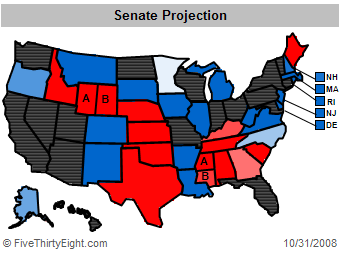
Senate Update: 3 Days to Go

Yesterday, we had 31 Senate polls, the same as the number of state polls for the presidency. From those numbers, we have a pretty good idea of where the most competitive races stand.

As a result of a Research 2000 poll that showed Mark Begich leading convicted felon Sen. Ted Stevens by 22 points in Alaska, I have removed that race from my list of competitive races. So, now we're down to seven races. Again, I've divided those races into three categories: Likely Democrat, Toss-Up, and Likely Republican. Here are the numbers:

Likely Democrat:

New Hampshire--Shaheen +9.2
It doesn't appear as though Republican incumbent John Sununu will make any last minute surges. Shaheen jumped 1.3% since yesterday's update. The race was polled heavily in the past few days, and they overwhelming conclude that this race is on the verge of being safe for the Democrats.

Oregon--Merkley +5.4
Jeff Merkley's lead has been confirmed by Research 2000 and Rasmussen. Nate Silver thinks think it's more likely that Merkley will win by double-digits than Gordon Smith will hold on to his seat.

North Carolina--Hagan +4.6
Kay Hagan responded to Elizabeth Dole's nasty ad implying that Hagan is an atheist with an ad of her own. But the original Dole ad seems to have backfired. Hagan jumped 2.4% since yesterday's update. Research 2000 puts Hagan 5 points ahead of Dole and a CNN/Time poll gives her a 9-point lead. This race does remain competitive, but I am confident in my decision to move this race to the "Likely Democrat" category.

Toss-Up:

Minnesota--Coleman* +1.0
This race could not be closer, and it is now the only true toss-up left. The only poll released since our last update from Research 2000 shows incumbent Norm Coleman with a 3-point lead over Al Franken. Nate Silver says that this race may be fairly independent from the trend nationwide and that he could see Coleman holding onto his seat even given a fairly bad night for the Republicans overall. NBC's Chuck Todd thinks Franken is the very slight favorite, but he also thinks Independent Dean Barkley will play a major role in who wins. Honestly, I am baffled by this race (especially given the third party wild card) and am just going to play it safe and call it a toss-up.

Likely Republican:

Georgia--Chambliss* +3.9
This race remains the best opportunity for the Democrats to pick up that 60th seat, but it is looking more and more out of reach for them. Incumbent Sen. Saxby Chambliss jumped up by about a point since yesterday, but the race is still very close. If Jim Martin can hold Chambliss to under 50%, he could force a run-off election on December 4. Can you imagine if the Democrats win 59 seats in the Senate and there was a run-off election here where they have a chance to pick up that 60th seat? The whole country would be focused on this one race, and it would be absolute pandemonium. Research 2000 puts Chambliss one point ahead of Martin.

Kentucky--McConnell* +5.1
This race remains virtually unchanged since yesterday. Research 2000 puts Sen. Mitch McConnell 3 points ahead of challenger Bruce Lunsford, and it is still winnable for the Democrats. The biggest wild card will be Democratic turnout on election day in this solid red state.

Mississippi (Special)--Wicker* +8.7
The Obama campaign does not have the extensive get-out-the-vote efforts in this state as it does in other states with competitive Senate races. I don't think that a surge in African American turnout will be enough for challenger Ronnie Musgrove to flip this seat, and Sen. Roger Wicker seems to be consolidating his advantage among whites. Research 2000 gives Wicker a 7-point lead over Musgrove.

So with three days to go, I project that the Democrats will have 56 seats to the Republicans' 42. If the Democrats want to get that 60-seat filibuster-proof majority, they better make a last-minute push in Minnesota and Georgia and make sure that their turnout is massive.

Regarding Rasmussen's Pennsylvania Poll

Rasmussen came out with a new poll from Pennsylvania earlier today that showed that Obama is only ahead in the state by 4 points there, 51-47. This is a large leap from the 7-point lead that Obama had in a poll that they took two days ago. This struck me as bizarre, so I looked into how the poll was conducted.

Here are some of the internals from the Pennsylvania poll they took today, and the internals from the poll they took three days ago are in parentheses:

Overall:
Obama--51% (53%)
McCain--47% (46%)

Among Whites:
Obama--46% (46%)
McCain--52% (53%)

Among Blacks:
Obama--80% (93%)
McCain--20% (5%)

Notice that the totals among whites remain virtually unchanged. But are we really supposed to believe that McCain jumped 15% among African Americans in three days? No.

These numbers are fishy to say the least. Nothing drastic has changed the race in the last three days, and even if it did, I would expect Obama's support among whites to go down, not among blacks. This is just a sampling error that Rasmussen made, and should be taken into account before all you Democrats start worrying too much.

Now, I have always thought that Pennsylvania was closer than the polls were indicating. I did not believe that Obama had a double digit lead over McCain a week ago. It is apparent that McCain is closing in the state to some extent--the Morning Call tracking poll in Pennsylvania shows that McCain has gained 3 points on Obama in the last two days. They have McCain down by 8 points in the Keystone State.

I believe that the margin is somewhere in the middle of these two polls, and Obama has a 6 or 7-point lead over McCain. But seeing as this where the race is likely to be decided, let's look at some Pennsylvania voting history real quick. In every election since 1984, Pennsylvania has gone bluer than the rest of the country. Take a look.

1984
Pennsylvania--7.3% Republican Spread
National--18.2% Republican Spread

1988
Pennsylvania--2.3% Republican Spread
National--7.7% Republican Spread

1992
Pennsylvania--9.0% Democratic Spread
National--5.3% Democratic Spread

1996
Pennsylvania--9.2% Democratic Spread
National--8.5% Democratic Spread

2000
Pennsylvania--4.2% Democratic Spread
National--0.5% Democratic Spread

2004
Pennsylvania--2.5% Democratic Spread
National--2.4% Republican Spread

Now, let's take a look at the 2008 Pennsylvania and National averages based on recent polling:

2008
Pennsylvania--9.0% Democratic Spread
National--6.2% Democratic Spread

So basically, if Obama wins the popular vote, he will win Pennsylvania.
Barack Obama's campaign manager David Axelrod announced today that Obama will not be visiting Pennsylvania in the last three days, which shows that they are fairly confident in winning the state. McCain's internals probably look a lot like the Rasmussen numbers, and that is why they are making this last-minute push.

Also, in 2004, John Kerry overperformed the polls by about 1.5% in Pennsylvania, so that should be taken into account when analyzing these numbers.

So, it still appears as though Obama does have some breathing room and I do think that he will win here. But I wouldn't take the state for granted.

Friday, October 31, 2008

State of the Race: 4 Days to Go

Many members of the media were talking today about how John McCain is "closing." Really? Because today's polls don't reflect that at all. In fact, Barack Obama increased his lead in the national tracking polls as well as in many state polls today. I guess the major networks want to say the race is getting closer so more people will watch.

We have 31 new state polls today. Here's the battleground state averages with four days to go before election day:

Missouri (11)--Obama +0.2
Indiana (11)--McCain +1.4
North Dakota (3)--McCain +1.4
North Carolina (15)--Obama +1.9
Florida (27)--Obama +2.9
Georgia (15)--McCain +3.8
Montana (3)--McCain +4.0
Ohio (20)--Obama +5.1
Arizona (10)--McCain +5.2
Nevada (5)--Obama +5.8
Colorado (9)--Obama +6.6
Virginia (13)--Obama +6.6
West Virginia (5)--McCain +8.5
New Mexico (5)--Obama +8.9
Pennsylvania (21)--Obama +9.6
New Hampshire (4)--Obama +11.0
Wisconsin (10)--Obama +11.3
Iowa (7)--Obama +11.7
Minnesota (10)
--Obama +12.4

TODAY'S ELECTORAL VOTE PROJECTION:
Obama: 364
McCain: 174


John McCain really can't afford to have a day where he does not make up any ground in the battleground states, let alone lose ground in them.

Since yesterday's update, McCain has gone down by a half of a point in New Mexico, largely due to the latest PPP poll that has him down by 17 there. Now, PPP is a left-leaning pollster, so I would translate that margin into something more like 13 or 14, which is still very strong. McCain has gone down almost two points in North Dakota as a result of a Research 2000 poll that puts him up by only one point in the state. Obama has started airing advertisements there again.

McCain continues to lose ground in Arizona, and now states like Colorado, Virginia and Nevada are more competitive than his home state. The Obama campaign has started advertising in Arizona yesterday as a result of these hopeful new numbers. But I must say, that is a bit obnoxious. I mean, there's no way that Arizona is going to decide the election--they just want to add insult to injury. But, I guess they have more money than they know what to do with.

We had six polls from New Hampshire out today, where Obama is leading from anywhere between 7-15 points. I think this slew of evidence shows that he is right on track to win there.

On top of that, the majority of Colorado and New Mexico have already cast their ballots through early voting, and early totals show that far more Democrats have showed up than Republicans so far. That does not bode well for McCain.

The key states of Missouri, North Carolina, Florida, Ohio, Nevada, Colorado, and Virginia remain unchanged since yesterday. McCain needs to be closing in these states, but instead Obama still has small or even some large leads in some of these states.

The only states that are moving in McCain's direction are Indiana, Montana and Pennsylvania. Two recent polls from Montana show that McCain is gaining slightly there, and his lead is just outside the margin of error. The same goes for Indiana, which looks to be more and more promising for McCain.

The only evidence where I see McCain "closing" is in Pennsylvania. But his gains are nothing to write home about. The Morning Call tracking poll has him down by (only!) 10 points, down a point from yesterday, while a Strategic Vision poll has him down by 5 points. But keep in mind that Strategic Vision has had a Republican lean and some very erratic polling in Pennsylvania all year. This result is probably what his campaign's internal polls looked like when they decided to go all-in there last week.

So basically, Pennsylvania is McCain's last chance. Even if he does pull off a miracle and win the Keystone state, it does not automatically mean victory for him. Obama has something of a firewall in Colorado, Virginia, and Nevada--totaling 27 electoral votes to Pennsylvania's 21. Even if McCain wins Pennsylvania, Ohio, Florida, Missouri and North Carolina (all states he's currently behind in), all Obama needs is those three firewall states and he has 270 electoral votes.

I'm sure the electoral map and all of the different scenarios for an Obama victory is giving McCain campaign manager Steve Schmidt nightmares.

Senate Update: 4 Days to Go

With four days before election day, it looks as though Barack Obama will win the presidency. But not we look to see what kind of Democratic majorities he'll be working with in Congress. The House of Representatives is harder to predict, but it looks as though Democrats are going to gain 20-40 seats.

The Senate, on the other hand, has become easier to predict with a flurry of new polling from the eight competitive races (where all of the seats are currently held by Republicans). I have separated these races into three categories: likely Democrat, toss-up, and likely Republican--along with the averages for each race. Currently, my averages project that the Democrats will have 56 seats, the Republicans will have 42 seats, and the Independents will have 2.

Likely Democrat:
In these three races, if nothing changes drastically in the next few days, it looks as though the Democrats will win these seats.

New Hampshire--Shaheen +7.9
Recent polls show that Jeanne Shaheen has been pulling away from incumbent John Sununu, and is currently ahead by somewhere between 5 and 13 points. But Shaheen's totals have not matched Barack Obama's totals in the state, meaning that there are some Obama-Sununu voters. I still pit Shaheen as a heavy favorite to pick up this seat, but given this state's independent streak, a good number of undecideds may break for Sununu in the final few days making the race closer than expected.

Alaska--Begich +7.6
After 40-year incumbent Sen. Ted Stevens was convicted on seven charges of corruption and is now officially a felon, this race was basically over. The two polls that have come put since then have had Democratic challenger Mark Begich up by 8 points and 22 points respectively. It will take a day or two before my average for this race to reflect those numbers, but it is clear that Begich will be the new senator from Alaska.

Oregon--Merkley +5.2
The race between incumbent Sen. Gordon Smith and Jeff Merkley was once considered to be a toss-up, but now it looks as though the race is breaking Merkley's way. He's led in the polls for over a month now, and a new poll from Public Policy Polling puts him up by 8 points, his largest lead to date. Smith has not had much help from the McCain campaign because they have not seemed to pick up any momentum in the state, and Smith basically has to fend for himself. Oregon only allows mail-in voting and early reports show that turnout is way down in typically Republican areas. Things are looking bleak for Smith. Expect this seat to flip.

Toss-Up:

These races really could go either way, but it appears that the Democrats have a slight advantage in North Carolina while the Republicans have a slight advantage in Georgia. Minnesota is still a dead heat.

North Carolina--Hagan +2.2
Democratic challenger continues to have a small yet significant lead in this race against one-term incumbent Sen. Elizabeth Dole. But in a state that is known for last minute mud-slinging nasty attack advertising, it comes as no surprise that the Dole campaign has released a controversial new ad, which implies that Hagan is an atheist. The ad points out Hagan's ties to a local atheist group that supposedly donated money to her campaign, and at the end of the ad an audio clip of a voice comes on and says "There is no God." Viewers are led to believe that the voice is Hagan's, though the Dole campaign has admitted that it is not her in the clip. Here is the infamous ad. If it is successful, Dole may keep her seat--but it also may backfire and cause her to lose by an even larger margin. Over the next few days, I will be looking to see what kind of an effect this has on the race.

Minnesota--Coleman* +0.2
Incumbent Sen. Norm Coleman has jumped up a point since my last update two days ago, but the polls for this race have been all over the place. Rasmussen and Mason-Dixon have Coleman up by 4 and 6 points, respectively. Public Policy Polling and Minnesota Public Radio have Al Franken up by 5 and 4 points, respectively. Such volatile polling is probably due to the fact that Independent candidate Dean Barkley continues to hold onto about 15% of the vote in this race. And if the Barkley vote collapses (which is likely), it is unclear who it is likely to break for. Basically, this race could not be closer and harder to predict.

Georgia--Chambliss* +3.4
Democratic challenged Jim Martin is polling a few points behind incumbent Sen. Saxby Chambliss in most recent polling. Chambliss runs into the problem of early voting, where the Democrats have shown up in huge numbers and where the Obama campaign is making a serious play for the state and upping its advertising and get-out-the-vote effort. Nate Silver of FiveThirtyEight.com seems to think that the polls have been lowballing Jim Martin because they have shown that there is a fairly high number of African Americans, who he thinks will vote for Democrats down the ticket, such as Jim Martin. Both Silver and I think this race is a true toss-up and something I will be keeping a very close eye on election night.

Likely Republican:
These two races were once thought to be toss-ups, but in the past week that have broken in the direction of their respective Republican candidates.

Kentucky--McConnell* +5.2
Senate Minority Leader Mitch McConnell looked to be in some serious trouble last week against Bruce Lunsford. But the last three polls taken show that McConnell has widened his lead again to about five points. Lunsford looked to be gaining ground on McConnell, but then his poll numbers stalled out at around 44%. He also is not going to have the up-ticket coattails that are bound to occur in states like North Carolina and Georgia. He's going to need the vast majority of the undecided vote to break for him if he wants a shot to unseat McConnell.

Mississippi (Special)--Wicker* +8.5
This race appeared to be tight until about a week ago, when a Press Register poll showed that Sen. Roger Wicker had an 11-point lead over challenger Ronnie Musgrove. Rasmussen's latest poll backed up that finding and showed Wicker up by 11 points. Musgrove, a conservative Democrat, has not been funded as well by the Democratic Senatorial Campaign Committee as candidates like Martin and Lunsford and appears to be heading towards defeat, barring a Democratic landslide.

So, all in all, it looks like the Democrats will have around 57-60 seats in the Senate. But the odds for picking up that 60th seat which would grant them a filibuster-proof majority--which would come from either Georgia, Kentucky, or Mississippi--are becoming increasingly unlikely.

Thursday, October 30, 2008

Ron Paul Could Be a Spoiler in Montana

It's been months since Ron Paul officially dropped out of the race for the Republican nomination. But the Libertarian-turned-Republican Congressman from Texas might still play a major role in the general election--well, at least in Montana.

The Montana Constitution Party nominated Paul in the summer, but he has not been campaigning in the state and has even asked supporters to write in Chuck Baldwin, the national Constitution Party candidate. Paul even asked the secretary of state’s office to remove his name from the ballot, but state officials said they couldn’t.

However, Montana Republicans are worried that Paul might draw away enough votes from John McCain to tip the state into Barack Obama's favor. Recent polls show the race tightening in this typically reliable red state, which has not voted for a Democrat since Bill Clinton in 1992, when Ross Perot siphoned off a large number of Republican voters from George H.W. Bush.

A recent MSU-Billings from the state showed that Paul was drawing 4% of the vote--the exact margin Obama was winning by. Other polls show that McCain has a slight lead in the state.

During the Republican primaries, some of Paul’s strongest support came in Montana. He received about 25% of the vote in the state’s June primary--even after it was clear McCain was the party’s presumptive nominee. Paul is especially popular in the western part of the state, where there a many independent and libertarian-minded voters--many of whom really like their guns, and don't trust McCain or Obama on that issue.

Obama has been pouring money and resources into Montana in attempt to flip the state, while McCain has largely ignored Montana, although the RNC will begin independently airing ads there this week.

Even though Paul's quest for the presidency is long over, the Ron Paul Revolution may live on to fight another day and make a difference on November 4--again, at least in Montana.

State of the Race: 5 Days to Go

We have 32 new state polls today. Here's the averages for the battleground states with five days to go before election day:

Missouri (11)--Obama +0.4
Indiana (11)--McCain +0.6
North Carolina (15)--Obama +1.8
Montana (3)--McCain +2.2
Florida (27)--Obama +2.7
North Dakota (3)--McCain +3.1
Georgia (15)--McCain +4.1
Ohio (20)--Obama +4.9
Nevada (5)--Obama +5.8
Arizona (10)--McCain +6.2
Colorado (9)--Obama +6.7
Virginia (13)--Obama +6.8
West Virginia (5)--McCain +8.0
New Mexico (5)--Obama +8.4
Pennsylvania (21)--Obama +10.1
Wisconsin (10)--Obama +10.4
New Hampshire (4)--Obama +11.1
Iowa (7)--Obama +11.2
Minnesota (10)
--Obama +12.4

TODAY'S ELECTORAL VOTE PROJECTION:
Obama: 364
McCain: 174

Both candidates get some good news from today's state polls, but overall the status of the battleground states has not changed very much. The national polls (which mean close to nothing) show McCain down by about 6 points. He needs to close that lead by about one point per day to have a chance in many of these states--and that is no easy feat when you have inferior ground operations, an inferior advertising budget and no real central campaign theme.

Over the past few days, every battleground state (except for North Dakota) have been polled and many of the major battleground states (Colorado, Virginia, Ohio, Florida, Nevada, Pennsylvania, North Carolina etc.) have been polled extensively. So we have a pretty good idea of where the race stands.

The good news for the McCain campaign comes from Indiana, where a Reuters/Zogby poll puts McCain up by six points. Rasmussen has him up by 3. However, an Indy Star/Selzer poll puts Obama up by one point, but that poll has had a Democratic lean this cycle. Notice that Indiana was the first state in over a week to change hands in my model. McCain now leads by 0.4 points overall, and I still consider it to be a toss-up.

Good news for Obama comes out of the upper Midwest today. He improved his position in Minnesota by two points since yesterday, as a result of a new Minnesota Public Radio that has him up by 19 in the state. SurveyUSA puts Obama up by 15 points in Iowa and 16 points in Wisconsin. These three states look like they're all out of play for McCain.

Obama is maintaining his small but significant leads in North Carolina, Florida and Ohio. McCain is holding on for dear life in Georgia.

Even if McCain somehow pulls off an upset in Pennsylvania, Obama may still counteract that with wins in Colorado, Virginia and Nevada, which would give him 270 electoral votes and thus the presidency. Obama has leads of 6 points or more in those three states right now and they may be just out of reach for McCain.

There's also some embarrassing news for the McCain campaign: he's running robocalls in his home state of Arizona. The calls mean Republicans are sinking resources into a state that obviously should have been a complete lock for McCain, and are not spending those resources in states like Indiana and Missouri, which are dead heats.

Wednesday, October 29, 2008

State of the Race: 6 Days to Go

There has been a ton of polling so far this week, so lets get to it. Here's today's battleground state averages:

Missouri (11)--Obama +0.2
Indiana (11)--Obama +0.7
North Carolina (15)--Obama +1.3
Montana (3)--McCain +2.5
North Dakota (3)--McCain +2.6
Florida (27)--Obama +3.0
Georgia (15)--McCain +4.1
Ohio (20)--Obama +5.4
Nevada (5)--Obama +5.7
Arizona (10)--McCain +6.0
Colorado (9)--Obama +6.8
Virginia (13)--Obama +7.0
West Virginia (5)--McCain +8.1
New Mexico (5)--Obama +8.3
Pennsylvania (21)--Obama +10.3
Minnesota (10)--Obama +10.4
New Hampshire (4)--Obama +10.5
Wisconsin (10)--Obama +10.7
Iowa (7)--Obama +11.4


TODAY'S ELECTORAL VOTE PROJECTION:
Obama: 375
McCain: 163


From my last update on Saturday, there have been 82 state polls. Most of them have been great news for Barack Obama and terrible news for John McCain. The battleground states should be tightening up at this point in the race, but it appears that Obama is expanding his lead, or at least maintaining it, in most of these states.

Since Saturday's update, Obama is up four points in New Hampshire, three points in Nevada, and one point in Colorado and Florida. New Hampshire is essentially a safe state for him now and Pennsylvania looks pretty out of reach--and those are the only two states that McCain has a chance to flip. Obama has double digit leads in both states. Sorry, John. So much for the Hail Mary pass.

I think something that truly signifies McCain's decline in the polls on a national scale is the most recent numbers from Arizona, his home state. The last three polls from Arizona have McCain up by 5, 2, and 8 points respectively. My average shows him up by about six points there. How embarrassing would it be if he lost his home state?

McCain has only made some minor gains in a few states since Saturday. He's up about two points in Missouri and about one point in Indiana, and West Virginia since my last update. He's pulled about even in Missouri, which is a relatively big step in the right direction in a state that he must win.

West Virginia looks like it's leaning more and more towards McCain again, but Obama has won a victory there in a sense in that he got the RNC to spend advertising money there. The RNC also dished out advertising cash in Montana this past week. Montana. Bush won by 21 points there, so you know the Republicans are in trouble. As Rachel Maddow said last night, that's comparable to the Democrats defending Massachusetts.

McCain better pray that something drastic happens in the next six days, like when Osama bin Laden came out with that video a few days before the 2004 election. That scared a lot of undecided voters into supporting Bush in the last few days, and helped tip the election in his favor. But Al Qaeda already endorsed McCain, so I guess that's out.

Senate Update: 6 Days to Go

It is a foregone conclusion that the Democrats will retain control of the Senate (as well as the House) this year, and that they will gain seats in both halls of Congress.

But the real question is whether or not Democratic Senatorial Campaign Committee (DSCC) Chairman Sen. Chuck Schumer and the Democrats can pick off enough seats to have 60 seats in the Senate. If the Democrats reach that 60-seat threshold, the Republicans cannot filibuster any legislation and Senate Majority Leader Harry Reid will have complete control over what gets discussed on the Senate floor.

Right now there are 49 Democrats, 49 Republicans, and 2 Independents. One of the Independents, Bernie Sanders of Vermont, always votes with the Democrats. The other Independent is Joe Lieberman of Connecticut, the former Democratic vice presidential nominee who now supports John McCain. In the past, he has generally voted with the Democrats except on foreign policy issues.

So if we include Sanders and Lieberman as Democrats, they have a 51-49 majority right now. Democrats are heavily favored to pick up the open seats in Virginia, New Mexico and Colorado, which were all formerly occupied by Republicans. Assuming the Democrats pick those three states up, they now have a 54-46 majority.

Now, let's take a look at the eight closest Senate races, all of which have Republican incumbents. The Democrats need to win six of the eight listed below to reach that 60-seat majority. I have averaged the totals of three poll averaging websites--RealClearPolitics.com, Electoral-Vote.com and FiveThirtyEight.com--for each of these eight races. The races are listed from most to least competitive--the Democrats are in blue and the Republicans in red, and incumbents are marked with an asterisk.

Minnesota--Franken +0.8
The Democratic candidate, Al Franken, is a former liberal talk show radio host and comedian. He is up against incumbent Norm Coleman, a moderate Republican who is suffering from the GOP voter apathy that is happening across the country. The polls have been all over the place for this race, but it looks like its about even with about a week to go before election day. Also of note is that the Independent candidate, Dean Barkley, is polling at around 17-20% right now and appears to be drawing an equal number of Democrats and Republicans. However, he might have just enough impact to greatly affect who wins this race. It should be a close one, and one that I'll be watching closely.

North Carolina--Hagan +2.0
One-term incumbent Elizabeth Dole, wife of Bob Dole, is facing the fight of her life against State Senator Kay Hagan. Dole was the chairwoman of the National Republican Senatorial Committee in the disastrous 2006 midterm elections. To many North Carolina voters, she represents the continuation of the policies of George Bush and the old guard, but still has excellent name recognition in the state. Hagan may benefit from up-ticket supporters of Barack Obama, especially among African Americans.

Alaska--Begich +2.5
40-year incumbent Senator Ted Stevens looked like he was polling even with Anchorage Mayor Mark Begich until he was found guilty on seven counts of lying on his Senate disclosure forms to try to hide illegal gifts he received from an oil services company executive. He could face up to 35 years in jail, and given his age (he is 84), that probably means life in jail. The DSCC has stopped pouring money into the race and it looks like Begich will flip that seat. No polls have been taken in Alaska since Stevens's verdict, so expect the gap to widen in the next 6 days.

Georgia--Chambliss* +2.7
This race is probably the best shot for the Democrats to pick up their 60th seat. This race was not supposed to be close, but incumbent Saxby Chambliss is now very narrowly ahead of former Rep. Jim Martin. Chambliss and the state GOP are facing the massive voter registration drives of the Obama campaign. Obama believes he can pick up the state and is only a few points behind John McCain in the polls. Like Kay Hagan in North Carolina, Jim Martin will benefit from African American up-ticket voters that will and already have showed up to vote for Obama. This is definitely a race to watch on election night.

Kentucky--McConnell* +3.8
Remember when Democratic Senate Minority Leader Tom Daschle lost his seat in the 2004 election? Well, the same thing might happen to Republican Senate Minority Leader Mitch McConnell this time around. Kentucky is usually a reliable red state, and Obama isn't making a strong push here like he is in North Carolina and Virginia. McConnell is favored to hold his seat, but is facing a surprisingly competitive race against wealthy businessman Bruce Lunsford. McConnell's ties to the Bush administration may be his demise, but his fundraising and incumbency advantage may save him.

Oregon--Merkley +4.3
Incumbent Gordon Smith is a moderate Republican in a Democratic state, and his chances at six more years do not look good. Smith has very low approval ratings in Oregon and is trailing his opponent, State House Speaker Jeff Merkley. This race is representative of the national Democratic swing and the tarnishing of the Republican name. Oregon does voting by mail only, so most Oregonians have probably voted, so even if Merkley (or Obama) makes a major gaffe in the last week, those votes are already in and the effects may not matter that much. All in all, this seat looks ripe to flip.

Mississippi (Special)--Wicker* +7.6
Roger Wicker took over Trent Lott's senate seat in 2007, and is facing former governor Ronnie Musgrove in a special election this year. Musgrove is a very conservative Democrat, maybe even more to the right of some Republicans in the Senate, but his seat would be an improvement over Wicker for the Democrats. The race looked close up until this past week, when the polls showed the race opening up in favor of Wicker. Barring a national Democratic landslide, this seat looks like a longshot for the Democrats. Georgia and Kentucky are more likely to put the Democrats over the 60-seat hump.

New Hampshire--Shaheen +8.0
Incumbent John Sununu is facing former governor Jeanne Shaheen in a rematch of the 2002 open seat contest. Back then, Sununu won by 4%, but that was during a period of Republican dominance. In 2006, Democratic governor John Lynch was re-elected by 47 points, both of the House seats in the state flipped from Republicans to Democrats, and Dems won the majority in both the state House and Senate, so the state is clearly shifting to the left. Sununu has drawn criticism from both the right and the left in his six years in office, and Shaheen has been ahead of him in almost every poll. This state is very likely going to switch over to the Democrats.

Saturday, October 25, 2008

Why is McCain Campaigning in Iowa?

Beats me.


Sarah Palin is campaigning in Sioux City, Iowa today, and John McCain will follow her tonight in Waterloo, CBS News' Scott Conroy reports:


The Democrats are maintaining a solid lead in the latest Iowa polls, and the state's dynamics would seem to suit the Democrats. Iowa was the state that catapulted Obama to the front of the Democratic pack after his victory in the state's caucuses in January, and John McCain finished a distant fourth in the Republican field.


Still, the Republicans have to compete in states with less than ideal conditions, and one GOP operative with strong Iowa ties recently told CBS News that internal polling numbers show that the state could be a lot closer than the polls indicate.


According to the RealClearPolitics polling average, Barack Obama has an 11.4 point lead over McCain. According to Electoral-Vote.com, McCain is down by ten points. FiveThirtyEight.com has him down by 12.4 points. Pollster.com has him down by 11.5 points.


Listen, John, your internals better have you a hell of a lot closer than those totals. Iowa, much like Pennsylvania, is essentially out of your reach. Instead of trying to make it seem like you're on the offensive, you should be in must-win states like Colorado and Virginia, where yeah, you're down, but you're certainly not out.


Why would you spend one of your precious few days (and a weekend at that) in a state that is all but out-of-play when you could be in states like Ohio, Florida, Missouri, or North Carolina, where Obama's leads are razor-thin?


I still contend that you should have fired your chief campaign strategists about a month ago, and now, they are completely delusional about your chances in states like Iowa. If you lose this thing--and right now it's looking like you are--people are going to make excuses that Barack Obama won because of the economic crisis or George Bush's legacy.


But another reason that most people will ignore is how badly your campaign has been run. This is not necessarily all on you, but it speaks volumes about who you surrounded yourself with in your campaign, and how they made a relatively good candidate run a terrible strategic campaign.


Take a lot at where Barack Obama and Joe Biden were today. Obama held rallies in Nevada then New Mexico, two pivotal states where he has a really good chance of winning, especially the latter. Biden was campaigning in Virginia today, one of the highly competitive states that is likely to put his ticket over the 270-electoral vote threshold on election night. That is how you are supposed to spend your last ten days before an election.


So get out of Waterloo, Sioux City, Pittsburgh, or Harrisburg or wherever you're going, and spend your last precious days and dollars where you have a remote chance of winning.